Wednesday, September 21, 2016

The Parabolic Tactical Diver: Germany's Laco Squad Atacama


A situation requiring immediate tactical intervention is taking place in Germany.  Highly trained and specialized federal police units which have trained for years for just such an occasion are en route via a number of highly tactical modes of transit.  They are equipped with the world's finest gear for diving, parachuting, and tactical operations.  As they arrive at the incident site in waning daylight each operator glances briefly at the highly luminescent indices on their mission-timer.  The PVD coated, 500m capable, parabolic shaped Laco Squad Atacama (also lovingly and confusingly known as the "Ninja") is a piece of kit every bit as essential as their rifles or plate carriers...  Or so our dear Freunden at Laco would have you believe.  And while the Laco Squad is probably not totally essential for tactical operations, this is one very cool, highly capable, and truly different watch.


Let's get down to business.  This watch is BIG.  The watch sports a 46mm perfectly circular case shape which tapers down from the unidirectional rotating count down bezel to the somewhat surprising transparent case back.  The screw down crown is positioned at the 12 o'clock spot which is intended to move it away from the back of the wearers hand.  The lugs are hinged to the case and hug the wrist making the much more comfortable than you would imagine as well as aiding the watch in wearability on smaller wrists.  A very minimal looking (über Bauhaus) dial, a tall chapter ring sporting the traditional 1-12 numerals, and the PVD coating make for a very all-business and tactical appearance which you will either love or hate.  Inside the 500m rated case, the trusty ETA 2824 keeps reliable and robust time.  This all makes for a pretty impressive resume but how well does it all work?


For starters, the size will be an issue for some as it is I think for me.  My wrist is at most about 6.25" (that's on a good day after a workout) and I always knew the Squad would be a pushing it for size.  However, as I mentioned the hinged lugs do aid the watch in having a short perceived lug to lug measurement.  Also, when worn on the stock rubber vent style diver's strap the lugs sort of blend into the strap making it look like the round part of the watch is the whole thing.  It doesn't feel like a large watch on the wrist.  For anyone with a more normal wrist size I think the Squad would look great.


The fit, finish, and attention to detail of the Germans at Laco is in keeping with the finest Swiss or Japanese watch manufacture.  The bezel has neatly engraved numerals which are filled with some kind of white paint which must be pretty durable as mine is a well used example and it's all still there.  The bezel's edge sports a neatly cross hatched design which makes it easy to grab with gloves on or without.  The time keeping on my recently serviced example is well within chronometer standards which seems to be possible with any well regulated 2824 equipped watch.

Tools of the trade.  
The lume is clearly Superluminova (green) and glows evenly throughout the night in keeping the watch's tactical concept.  The strap as a mentioned is also a nicely executed rubber vent strap which comes in two lengths with one being for daily wear and another longer one for use with a wetsuit.  The shorter length strap makes it so that even with a very small wrist and the hinged lugs I don't have six inches of strap "tail" hanging off my wrist.  This is because even the saltiest diver mostly wears their watch while not diving and being comfortable out of the water matters too.  My dream is that someday Seiko will come out with short length Z series straps for their divers.

Probably too big for me, but really cool nonetheless.  
This is an impressive watch but the Laco is not perfect.  The watch suffers in some way from an identity crisis.  Is it a diver or more of a tactical mission timer concept?  Why the heck is a German made tactical diver named after the Atacama desert of South America?  An example of the discord is the countdown bezel.  If you're going to go through the trouble of rating the watch to 500 meters and including a wetsuit strap then I'd prefer a traditional elapsed time bezel.  In fact, as someone who often dives sans computer, I'd likely choose another watch for my diving needs.  Although I can't claim to be a tactical operator, I can imagine the watch would suit those needs adequately though so too (the US military would argue) would a $40 G-Shock.

Though the case design is old, it is still highly unique in today's watch-scape.  L-R: A vintage Preziosa diver, the Squad's smaller quartz brother, and the Atacama on the right.  
The main selling point here is in the uniqueness of the watch.  This particular parabolic case has been utilized by other brands before but never in large numbers.  At the moment nothing looks even remotely like the Squad except for the offensively overpriced and under engineered ZRC rerelease.  The Squad and Laco deserve respect for unapologetically daring to be different.  The minimal, highly teutonic design of the Atacama combined with the impressive list of features makes the watch an insane value for the $5-800 you're likely to spend but the polarizing nature of the design will keep this watch in the hands of those who want to wear something totally different.  I'd argue that Laco is perfectly OK with that.

Absolutely a great watch for... drinking on a sailboat?  The Laco Squad is huge and makes a statement.  It is probably the most often asked about watch I own.  

Tuesday, August 16, 2016

Chicago: The Big Move and the Future of BottomTimer.com


My beautiful wife and I celebrating my graduation from commercial diving school.  Man, I already miss SB.  
It's hard to believe I haven't written here since mid May.  All I can say in my defense is that life has been... well, crazy.  I graduated from dive school sometime right around then (YESSSS!)  Also in that time, my wife and I have moved from sunny Santa Barbara, CA to also sunny (for now) Chicago, we've gotten new jobs, and we're learning how to live in a new and much more urban setting.  Though it was a difficult decision making process for us the choice to move here hinged on several important factors.

Diving momentos in our new home in Chicago.  
For one, as a new graduate of commercial diving school I was forced to look upon the bleak state of the current commercial diving industry.  As you may imagine, when oil prices are where they're at (low) the amount of diving tasks and underwater construction projects winds down significantly making good entry level diving jobs hard to find.  My professors ensure the cyclical nature of the industry will see it swing up in the next few years but what is there to do with the next few years?

We stopped by my Mom's house in Denver during our move.  
 My wife and I ultimately decided on hitting a few birds with the one stone, the stone being the move.  The move brings us very close to family for the first time in years, enables a scene change for both of us as far as jobs, and enables me to continue my education with the help of the GI Bill.  I start at DePaul University in a few weeks and I'm excited to get going and finally finish my bachelor's degree.  This way, when the the diving industry gets going again I'll be even more educated and ready for a hopefully lengthy career underwater.  

It's hard to not love Chicago when you go sailing on Lake Michigan.  We're pretty scared about the whole Winter thing though...
Now, what does all of this mean for BottomTimer.com, whose dedicated fans have been sitting on the edge of their seats for weeks?  I'm not going anywhere.  My love for diving and the diving world will not falter and I will continue to bring you content which I feel is worth checking out.  There may be some slight deviation in terms of the nature of my posts as I probably won't be hard hat diving any time extremely soon but you can still expect dive watch reviews, diving articles, and maybe a few scuba trips from yours truly.  It blows my mind to see that my little blog has been viewed ten thousand times.  I'm thankful and motivated to make it better than ever.  Stick with us.

Coming soon: A review of this sea monster from Laco.  BottomTimer.com is going nowhere.  

Saturday, May 21, 2016

The Last Great Issued Diver's Watch: The Marathon GSAR


Nowadays, some of the most collectible and valuable watches in the world are those with military provenance.  The best example is of course the British Rolex Mil-Sub with the most pristine models hammering for $100,000US at auction. This is a more recent swing in the world of watch collecting where auctions of years past dealt with more complicated or fancy (think Patek or fancy chronographs or multiple complications) watches.  The world of collecting, fueled by a new, younger generation of collectors, has become obsessed with the story of the watches themselves.  People now care about how and when the watches were worn and used and not only about the piece itself.  The coolness matters and recent prices are proving there's nothing cooler than military issued dive watches and the stories of their wearers.

Without a doubt the Rolex Military Submariner is the most badass issued diver of all time but with prices around $100k, I'm out.  
However, the watches we're talking about belong to another generation.  The issued Rolex and Tudor Submariners, the Blancpain Fifty-Fathoms, the closely related Tornek-Rayville, and even the Benrus Type I and II's all belong to a different time for the militaries of the world, an analog time (watch pun).  In fact, the arrival of the digital watch and specifically the venerable Casio G-Shock fortold the end of a great era of military watches by doing just about everything as well or better and being well, cheap.  The US Navy for example, once the buyer and user of many high-end, Swiss-made, automatic watches, has completely and totally shifted their focus to the mighty, digital G-Shock.  In many ways, the automatic watch in military use is dead.  Even the British, with a very strong history of military watches, seem to have kept the analog flame alive but moved on to quartz models like the CWC RN Diver's and the Citizen Eco-Drive 300m.

All business.  
There is, to my knowledge (and I could be wrong and would love to cause a heated discussion), only one Swiss automatic diving watch being currently issued by a military and it is the Marathon GSAR issued by the Royal Canadian Air Force to their Search and Rescue Technicians.


RCAF SAR Techs being lowered hoisted from a perfectly good helicopter.  Apparently, you need a pretty solid watch for this sort of thing.  Enter the Marathon GSAR.  
These guys are intense.  Trained in parachuting, rescue diving, survival, first aid, navigation, skiing, mountaineering, and probably other stuff, the SAR tech deploys from either a fixed or rotary wing aircraft to provide aid to people in need all over Canada's vast wilderness.  As one can imagine, the going is hard and a burly watch was deemed necessary.

The first version of the SAR watch from 2001 with a traditional SuperLuminova dial.  This one has had the obnoxious cyclops removed.  
The Marathon SAR series was, in an unprecedented and very cool move, designed and built with input from watch collectors (nerds like us).  The Canadian government contacted the also Canadian Marathon Watch Company and asked for a new, robust diver's watch and Marathon in turn contacted the owner of the Military Watch Resource forum and a government machinist.  Together, they came up with the first in a series of watches built specifically for hard use in the world of search and rescue which was initially issued in 2001.  Though updated a number of times over the years, most prominently with a tritium gas illuminated dial, the watch case and style has remained basically the same.  This watch is also available for unit purchase in the United States military although there's little evidence it was ever "officially" issued.  The US model is even marked with "US GOVERNMENT" on the dial.  

Sometimes, you need or want a quartz.  Marathon has you covered with the TSAR, supposedly issued to NASA divers.  
Over time, the watch became popular and it was made available in the civilian market where collectors grew interested.  As a result, there's now a selection of variations within Marathon's line.  There's the automatic, 42mm GSAR (ETA 2824), the quartz powered TSAR (ETA F06), a humongous 46mm JSAR quartz, and the also huge 46mm CSAR chronograph (Val. 7750).  All of the original size SAR watches feature a custom machined 300m case, a tall and easy to grab rotating diver's bezel, a thick sapphire crystal, tritium illuminated dial, screw down crown and caseback, and a  Italian rubber strap. It's probably the most purpose oriented designed diver's watch on the market, pure tool watch.  It's pretty clear the watch was intended from day one for hard use by highly trained military members and not Madison Avenue style.  

The GSAR seems to work well for a little parachuting. 
More than anything, what I like about the GSAR is how attainable it is.  I'll never have a Military Submariner.  Though I'd stupidly probably spend that much if I had it, my wife would kill me.  The GSAR at full gas retail is $1150 or so but you should never pay that much.  Barely used models go for between $6-800 on the watch forums and with a watch this tough, being slightly used is no big deal.  Further, the GSAR is insanely wearable.  At 42mm,  it wears just a hair larger than the Submariner, mostly because it's tall.  The supplied rubber strap is awesome and Marathon even makes a super high end bracelet for the watch as well.  With its military styling, the watch looks amazing on a NATO or other nylon strap.

Ok, so you might not do this but if you did, the Marathon GSAR could provide time telling services.  
As a serial watch owner and flipper, I somehow always come back to the Marathon watches, particularly the GSAR.  As a former Coast Guard search and rescue boat operator, I've used the watch for it's intended purpose and it is insanely capable.  The nighttime visibility of the tritium is perfect for the maritime environment and intense durability meant I never gave the watch a second thought.  In my new life of diving, the watch is a reliable brick shit-house as well.  The bezel operates well no matter what gloves I'm wearing and the underwater visibility is perfect.  In short, get one.  You won't be disappointed.  It's Swiss made, will do everything the Rolex Submariner will do, and looks a hell of a lot more interesting. 

Oh, here's a bunch of cool photos.  Thanks for reading.  

At the helm of my ol' Coast Guard boat.  Man, do I miss that job.  
Works even when wet!  
The original did have an awesome dial layout.  

Just the essentials, a GSAR and the .357.  Life is good on my Father-In-Law's farm in Wisconsin.  
By the way, if there was any doubt the GSAR is still issued, here it is with all of the SAR Tech's initial issue.  What a nice bunch of kit they get!  I guess they need it.  


Bam, issued diver's watch gold.  Way to go Canada.  

Thursday, May 12, 2016

Vietnam War Diver's Watch Style: The Olongapo Band


One of the coolest compliments to any vintage diver's watch is the "Olongapo" bracelet.  These custom made, stainless steel watch bands were and are associated with the Philippines and Olongapo City in particular.  If you're into collecting watches from the Vietnam War era such as old Rolex or Tudor Subs, the classic Seiko 6309 or 6105, Benrus Type Is and IIs, or the often under appreciated Zodiac Sea Wolf, then you've probably already seen some of these Olongapo bands.

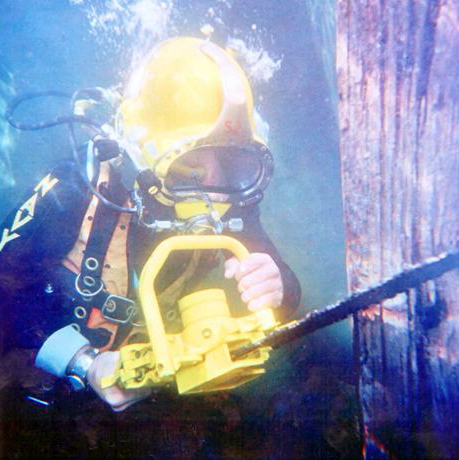
Royal Australian Navy Clearance Diver just casually using an underwater chainsaw, wearing a Kirby Morgan 17, and rocking the Olongapo.  This is perhaps the coolest photo that ever was.  
A Royal Australian Navy Clearance Diver wearing an Olongapo.  
USN UDTs in Vietnam.  
Various specialized military units (UDTs, SEALs, Rangers, Special Forces, Navy divers, etc...) spent a great deal of time on or near the Subic Bay Naval Base (decommissioned in 1992) while on leave from the war.  Olongapo City is in close proximity to Subic Bay and service men visiting the city began commissioning local artisans to produce stainless steel watch bands for their service watches which were customized with various military insignia.  At some point, a trend developed and many jewelry makers in Olongapo were soon producing these bracelets for the US and other military members.  Many of these bands, being built like a brick shit-house, have survived and assist in telling the story of the watches they accompany and the brave men who wore them.  

This is a screen grab from a movie about Air Force Pararescue men.  They too were rocking the Olongapo.  
In fact, there is still at least one highly talented maker of this style of watch bracelet.  His name is Jaffy Jurado and he runs an online business producing Olongapo bands mostly for collectors.  For a reasonable sum he'll make you a custom made watch band for your exact wrist size and particular watch.  As a Coast Guard veteran, I was interested in having one made with some insignia from my service.  Jaffy seems to have already used every insignia you can imagine but the Coast Guard's coxswain insignia (think pilot's wings for a boat driver) were a new one for him.  I wanted that on one side of the watch band and for the other I wanted the crossed anchors which signify my rate, Boatswain's Mate.  I don't mean this to be a commercial for Jaffy's work but he really is something else.  I was extremely impressed with the fit, attention to detail, and accuracy of my band and he even engraved the inside at no additional charge.  I'll put his email at the end of this post.  Here is a bunch of cool pictures.


And here a few pictures of mine!  I really couldn't be more pleased.  I went with the 22mm lug spacing to enable the band to be used on my many Seiko watches.


Pictures from Jaffy's workbench.  You can see the attention to detail is very impressive.  
It's a pretty nice watch bracelet for desk and or bar diving as well.  
As I promised.  Here's the email address for Jaffy:  olongapobands@gmail.com.  You can't go wrong!

Thanks for reading!  

Saturday, May 7, 2016

Vintage US Navy SEALAB Videos Worth Watching... Vintage Dive Watch Content.


A common overlap in the world of collecting is a fondness for vintage diving watches and a fondness for the era of diving when those watches were essential tools and not the fashion accessories for the cafe going, craft beer sipping collectors which they have unfortunately become.  We're talking about the Blancpain Fifty Fathoms, its military cousin the Tornek-Rayville, the Rolex Submariner, and eventually, the Rolex Sea-Dweller.  In few cases were these watches more essential than in operation with the world's navies.  

In military use, these watches saw a level of day in, day out ass kicking which is difficult to fully comprehend and their continued operation as diving tools is evidence of the extreme build quality of the watches.  The US Navy's SEALAB experiments, part of the Man-in-the-Sea program, which lasted from 1964 till their tragic end in 1969, proved the legitimacy of deep water saturation diving.  Of course, all of that diving required some high quality time pieces which make these SEALAB pictures and videos all the more awesome.

The Navy looks to have done all of their own recording and production on these classic, very vintage looking videos and the watch spotting is second to none.  I'll throw in some awesome photos after the videos.  Thanks for reading.

Here are the US Navy documentaries for SEALAB I, II, and III.


And here are some photos which I think are ridiculously cool.  Not the use of the Submarine along with a wrist mounted compass by almost every diver.  

Robert Barth, now retired USN Bos'n, wearing a Rolex Submariner.  If you don't know who this guy is, you're blowing it.  
USN Commander Malcolm Scott Carpenter (1925-2013) was an Mercury astronaut as well as a SEALAB aquanaut having been involved in both SEALAB II and III.  During SEALAB II, Carpenter spent 30 days in the undersea habitat before decompressing and surfacing.  He also sports the venerable Rolex Submariner.  
They came up with pretty cool uniforms for SEALAB.  The issue watches weren't too bad either.  
Very few have dived harder or longer than these guys.  It's a shame that the SEALAB program was almost completely overshadowed by NASA's space exploration as it was in many ways equally dangerous and ground (water?) breaking.  

Friday, May 6, 2016

Diving Heavy Gear, the Kirby Morgan Air Hat (and others)


As a follow up to my previous post, I'd like to also make note of the other various diving apparatus my class got to use the other day.  In addition to the MkV, we also had the opportunity to go diving with the Kirby Morgan Air Helmet or KMAH-1 which while much lighter than the MkV is still considered "heavy gear."  I did not personally dive this hat but I have some great pictures of the KMAH-1 in use which deserve to be shared!

But first, here's an abbreviated and poorly researched history of the hat!


Probably produced by Bob Kirby and Bev Morgan sometime around 1965, the Air Helmet was intended to be a better diving apparatus for undersea work, specifically construction and fishing for such critters as abalone.  This new style helmet was much lighter than other diving helmets of its day and featured very large, plexiglass lights which made it easier to see what you're doing on bottom.  Also, improvements were made to air inlet systems allowing for better, quieter airflow and improved communications.  Functioning much like the MkV with a breastplate, screwed on helmet, and drysuit,  the KMAH-1 was an improvement over existing diving technology while not constituting the complete change in the style of system which Kirby Morgan would later produce.

On to the photos!  There's also a few appearances from other diving systems including some cool full face scuba masks and I'll attempt to describe them where they appear.   Photo credit once again to Mr. John Ruhl.  Without his photographic efforts, I would have been hard pressed to create such an incredible piece of journalistic art.  National Geographic should be calling me up anyday now...  Here's John Morgan getting dressed in the Kirby Morgan Air Helmet getup and getting a dive in!


As you can see, John is a large gentleman and it took some doing to get the suit on him.  


And now for a few of the other interesting things we got to take diving...

Here's a classic USN Jack Brown "full face" scuba mask on the left and a new OTS diving mask on the right.  
Left to Right: USN MkV, Kirby Morgan EXO 26, Kirby Morgan Air Helmet.
And a misty Miller-Dunn style helmet we primarily use a doorstop.  It works for diving and door stopping.  
I have no idea on this one.  Please, someone inform me.  
Different eras of heavy gear diving hugging it out.  
The brave and handsome author sporting the prototype Mod 1 from Kirby Morgan as well as the classic Doxa 1200t diving watch.