Showing posts with label Vintage Diving. Show all posts

Saturday, November 19, 2016

CWC SBS Diver's Watch: A Currently Issued Tool Watch Reviewed


If you're a tool watch person, then you're aware of CWC.  If you're not, you're about to be!  The British brand has been producing watches (they're made for CWC in Switzerland) since 1972.  Founded by Ray Mellor, former UK distributor for Hamilton Watches, the brand has supplying the Ministry of Defense (MOD) since their inception.  In their 44 years of existence, CWC has supplied tens of thousands of their W10, G10, and somewhat fewer chronograph models to the British Army, Royal Navy and Royal Air Force.  In addition, they've supplied at least hundreds of their 300 metre (spelled that like that for you Brits) divers to Royal Navy divers, the SBS, and other "specialist diving units".


All of the watches CWC makes are purpose built, whether for pilots, infantry, or divers.  With that in mind, their designs are all business and their watches are intended to handle a beating.  In a world where most military organizations use G-Shocks, it's refreshing to see that some still believe in an overbuilt analog watch when the going gets tough.

I've owned almost every CWC, except for the automatic diver model and the chronograph.  I keep coming back to the brand because they sell you a solid, dependable Swiss made tool watches for a reasonable price.  In this review, I'll be taking my dedicated readers through the CWC SBS diver's issue watch, as CWC calls it.  It's an instant classic based on the basic CWC Royal Navy diver which takes many design cues from previous Royal Navy issued watches like the Omega Seamaster 300 and the mighty Rolex Mil-Sub.  The SBS differs in that it has a PVD coating for durability and low reflectivity (for when you're operating secret squirrel-like) and a Swiss day/date movement.  They were supposedly designed after SBS operators requested a version of their CWC divers which were less reflective.

If this is your commuter, you might just need the CWC SBS.  It also works pretty well for less extreme efforts.  
For full disclosure, I've owned this model before.  I regretted selling my first example and always wanted another one but never got around to getting one until CWC so kindly informed us, the watch nerd public, they were once again being issued.  CWC had several Instagram posts which I'll reproduce here which showed the SBS diver's watches being packed up and sent to the MOD, pretty freaking cool.

This is a cool shot because it shows the serial numbers of the watches being sent to the MOD.  
This one shows that they're apparently sent with straps separate.  It looks like they all get the most basic grey Phoenix G10 with stainless steel hardware.  


Apparently, this is how they get sent out to the MOD after being carefully arranged for Instagram photos.  
I couldn't resist and ordered one straight away after selling a watch or two to fill up the ol' PayPal.  After a two week hold in the evil vortex which is postal customs in Chicago, the watch arrived to my door.  Here's the obligatory and completely staged opening the CWC tin shot...


To start with the basics, here are some stats.  The watch is 40mm wide, about 47mm long, and 11mm thick.  The case is essentially the very classic Monnin style made famous by Heuer and others but with solid lug bars which necessitate the use of a pull through strap like a nato or zulu.  The watch features 300 metres of water resistance, a positive feeling, 60 click, one-way bezel, a screw down crown (obviously), and a ETA 955.122 Day/Date movement with an end of life indicator.  It comes on a British made Phoenix nato strap (more on that later), housed in a  simple little tin.  Once again, it's all business.

The SBS is extremely comfortable on the wrist, being fairly lightweight and also needing to be worn on a nato.  This photo shows the stock Phoenix nato in grey.    
On the wrist, it's pure joy.  This watch is one of my all time favorites.  It's relatively short lug to lug and not very wide either.  It wears about like a Submariner and plays very well on smaller wrists like my own.  The fact that the watch can only be worn on a nato and has a quartz movement makes for a very light overall package which is extremely comfortable.  I sleep with it on and completely forget it even exists until I need to read the time from the incredibly legible dial.  The SuperLuminova on the dial glows brightly all through the night even after limited exposure to light and is green in color.  The SuperLuminova is a recent advancement as previous versions had tritium lume.  Though I haven't taken the watch diving yet, I will and I promise to GoPro the hell out of the experience.


After the removal of VAT from the price of this watch, it was a fairly reasonable buy at around $500USD.  However, shortly after I purchased mine, CWC raised the price significantly to about $615USD shipped to the US.  Though that's a lot more money, it's still a lot of watch for the price.  Quartz will scare some away, especially at that price, but the watch is an instant favorite and the quartz movement makes it a real grab and go piece which can handle just about anything.  You can try to wait for a used one, but they come up for sale on the secondary market very rarely and are snapped up quickly.  That should tell you something by itself.

The color also varies from batch to batch with Phoenix straps.  

Older Phoenix on the left, note the smaller keepers which are not stainless steel.  On the right, the new Phoenix which has stainless keepers (and a signed buckle) but is thinner and cheaper feeling.  
 And now for a brief note on Phoenix nato straps.  They are, without a doubt, the most authentic option out there when it comes to a British mil-watch or a nato strap in general.  However, their quality varies from one to another (probably production batch by batch) and some are pretty thin and flimsy like those which came with my watch.  Now I'm a watch nerd and have a lot of natos lying around but for someone who doesn't, you might want to grab something heavier to go with your SBS if you pick one up.  I put mine on a vintage Phoenix I had lying around which is much thicker and balances out the watch head much better.  As a diver, I always want the most secure strap setup for a diving watch and the included Phoenix straps just really didn't hit the mark for me.  I'm sure they're fine for desk diving.  It's worth noting that the watch comes with a black nato with PVD hardware and the issued version probably ends up on the standard grey nato with stainless steel hardware.  If you want the "real" look, you've got to go grey!

SBS here with a somewhat flashier friend from the deep...
All in all, this is an awesome, highly capable watch.  If you're going for a classic watch design with military roots and tactical flavor, the SBS is for you.

Tuesday, November 15, 2016

Vintage Diving Videos: The MkV Diver's Dress


The iconic MkV (pronounced "mark five") diver's dress has been around.  Originally produced in 1916, the classic helmet was used by the US Navy all the way up till 1980.  It was used concurrently by military organizations and commercial divers all over the world.  It is perhaps the most iconic symbol of diving and its likeness is often used as a logo by military divers, commercial diving companies, and even scuba enthusiasts (funny how that works).   Because they are huge pieces of brass, extremely durable, and relatively simple in construction, there are still many MkV hats in existence and many are still in dive-able shape.  I got the chance to dive one at the end of commercial diving school and it was an experience I'll remember forever, not only because the whole rig weighed about 175 pounds... One of the coolest parts of diving the MkV was the care and tradition in how you put on the dress (dress as in diving helmet, drysuit, boots, weights, etc... not cross-dressing).  It's a slow and careful process intended to ensure everything is where it needs to be and put on the diver correctly.  The method by which the tenders dress the divers is standardized and done the same way every time.  The US Navy even produced some classic videos showing the process which I'll attach here.


Ok, that last one is me diving the MkV in dive school.  I think this video is on BottomTimer somewhere already but it's my pride and joy so here it is again and here are a couple pictures from the day.  


Thursday, May 12, 2016

Vietnam War Diver's Watch Style: The Olongapo Band


One of the coolest compliments to any vintage diver's watch is the "Olongapo" bracelet.  These custom made, stainless steel watch bands were and are associated with the Philippines and Olongapo City in particular.  If you're into collecting watches from the Vietnam War era such as old Rolex or Tudor Subs, the classic Seiko 6309 or 6105, Benrus Type Is and IIs, or the often under appreciated Zodiac Sea Wolf, then you've probably already seen some of these Olongapo bands.

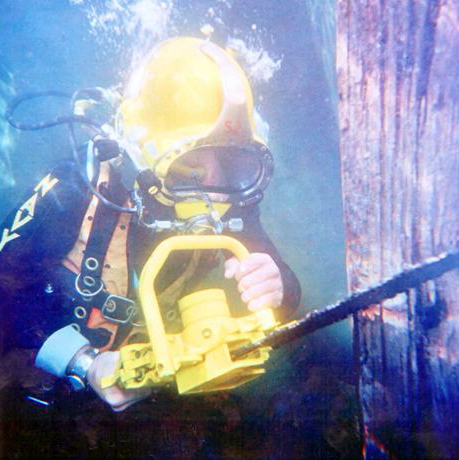
Royal Australian Navy Clearance Diver just casually using an underwater chainsaw, wearing a Kirby Morgan 17, and rocking the Olongapo.  This is perhaps the coolest photo that ever was.  
A Royal Australian Navy Clearance Diver wearing an Olongapo.  
USN UDTs in Vietnam.  
Various specialized military units (UDTs, SEALs, Rangers, Special Forces, Navy divers, etc...) spent a great deal of time on or near the Subic Bay Naval Base (decommissioned in 1992) while on leave from the war.  Olongapo City is in close proximity to Subic Bay and service men visiting the city began commissioning local artisans to produce stainless steel watch bands for their service watches which were customized with various military insignia.  At some point, a trend developed and many jewelry makers in Olongapo were soon producing these bracelets for the US and other military members.  Many of these bands, being built like a brick shit-house, have survived and assist in telling the story of the watches they accompany and the brave men who wore them.  

This is a screen grab from a movie about Air Force Pararescue men.  They too were rocking the Olongapo.  
In fact, there is still at least one highly talented maker of this style of watch bracelet.  His name is Jaffy Jurado and he runs an online business producing Olongapo bands mostly for collectors.  For a reasonable sum he'll make you a custom made watch band for your exact wrist size and particular watch.  As a Coast Guard veteran, I was interested in having one made with some insignia from my service.  Jaffy seems to have already used every insignia you can imagine but the Coast Guard's coxswain insignia (think pilot's wings for a boat driver) were a new one for him.  I wanted that on one side of the watch band and for the other I wanted the crossed anchors which signify my rate, Boatswain's Mate.  I don't mean this to be a commercial for Jaffy's work but he really is something else.  I was extremely impressed with the fit, attention to detail, and accuracy of my band and he even engraved the inside at no additional charge.  I'll put his email at the end of this post.  Here is a bunch of cool pictures.


And here a few pictures of mine!  I really couldn't be more pleased.  I went with the 22mm lug spacing to enable the band to be used on my many Seiko watches.


Pictures from Jaffy's workbench.  You can see the attention to detail is very impressive.  
It's a pretty nice watch bracelet for desk and or bar diving as well.  
As I promised.  Here's the email address for Jaffy:  olongapobands@gmail.com.  You can't go wrong!

Thanks for reading!  

Saturday, May 7, 2016

Vintage US Navy SEALAB Videos Worth Watching... Vintage Dive Watch Content.


A common overlap in the world of collecting is a fondness for vintage diving watches and a fondness for the era of diving when those watches were essential tools and not the fashion accessories for the cafe going, craft beer sipping collectors which they have unfortunately become.  We're talking about the Blancpain Fifty Fathoms, its military cousin the Tornek-Rayville, the Rolex Submariner, and eventually, the Rolex Sea-Dweller.  In few cases were these watches more essential than in operation with the world's navies.  

In military use, these watches saw a level of day in, day out ass kicking which is difficult to fully comprehend and their continued operation as diving tools is evidence of the extreme build quality of the watches.  The US Navy's SEALAB experiments, part of the Man-in-the-Sea program, which lasted from 1964 till their tragic end in 1969, proved the legitimacy of deep water saturation diving.  Of course, all of that diving required some high quality time pieces which make these SEALAB pictures and videos all the more awesome.

The Navy looks to have done all of their own recording and production on these classic, very vintage looking videos and the watch spotting is second to none.  I'll throw in some awesome photos after the videos.  Thanks for reading.

Here are the US Navy documentaries for SEALAB I, II, and III.


And here are some photos which I think are ridiculously cool.  Not the use of the Submarine along with a wrist mounted compass by almost every diver.  

Robert Barth, now retired USN Bos'n, wearing a Rolex Submariner.  If you don't know who this guy is, you're blowing it.  
USN Commander Malcolm Scott Carpenter (1925-2013) was an Mercury astronaut as well as a SEALAB aquanaut having been involved in both SEALAB II and III.  During SEALAB II, Carpenter spent 30 days in the undersea habitat before decompressing and surfacing.  He also sports the venerable Rolex Submariner.  
They came up with pretty cool uniforms for SEALAB.  The issue watches weren't too bad either.  
Very few have dived harder or longer than these guys.  It's a shame that the SEALAB program was almost completely overshadowed by NASA's space exploration as it was in many ways equally dangerous and ground (water?) breaking.  

Friday, May 6, 2016

Diving Heavy Gear, the Kirby Morgan Air Hat (and others)


As a follow up to my previous post, I'd like to also make note of the other various diving apparatus my class got to use the other day.  In addition to the MkV, we also had the opportunity to go diving with the Kirby Morgan Air Helmet or KMAH-1 which while much lighter than the MkV is still considered "heavy gear."  I did not personally dive this hat but I have some great pictures of the KMAH-1 in use which deserve to be shared!

But first, here's an abbreviated and poorly researched history of the hat!


Probably produced by Bob Kirby and Bev Morgan sometime around 1965, the Air Helmet was intended to be a better diving apparatus for undersea work, specifically construction and fishing for such critters as abalone.  This new style helmet was much lighter than other diving helmets of its day and featured very large, plexiglass lights which made it easier to see what you're doing on bottom.  Also, improvements were made to air inlet systems allowing for better, quieter airflow and improved communications.  Functioning much like the MkV with a breastplate, screwed on helmet, and drysuit,  the KMAH-1 was an improvement over existing diving technology while not constituting the complete change in the style of system which Kirby Morgan would later produce.

On to the photos!  There's also a few appearances from other diving systems including some cool full face scuba masks and I'll attempt to describe them where they appear.   Photo credit once again to Mr. John Ruhl.  Without his photographic efforts, I would have been hard pressed to create such an incredible piece of journalistic art.  National Geographic should be calling me up anyday now...  Here's John Morgan getting dressed in the Kirby Morgan Air Helmet getup and getting a dive in!


As you can see, John is a large gentleman and it took some doing to get the suit on him.  


And now for a few of the other interesting things we got to take diving...

Here's a classic USN Jack Brown "full face" scuba mask on the left and a new OTS diving mask on the right.  
Left to Right: USN MkV, Kirby Morgan EXO 26, Kirby Morgan Air Helmet.
And a misty Miller-Dunn style helmet we primarily use a doorstop.  It works for diving and door stopping.  
I have no idea on this one.  Please, someone inform me.  
Different eras of heavy gear diving hugging it out.  
The brave and handsome author sporting the prototype Mod 1 from Kirby Morgan as well as the classic Doxa 1200t diving watch.